
Our Short List of 3

- Best for: Homeowners who want strong whole-house backup with remote start and a clear hour meter.
- 12,500 peak watts and 9,500 running watts on gasoline
- 11,200 peak watts and 8,500 running watts on propane
- Heavy-duty 457cc 4-stroke OHV engine with a cast iron sleeve
- Digital hour meter with VFT display for voltage, frequency, and lifetime hours

- Best for: Large homes and buyers who need maximum running watts for heavy appliances.
- 13,000 peak watts and 10,500 running watts on gasoline
- Dual fuel operation on gasoline or propane
- 500cc OHV engine
- Hour meter listed in the Amazon special features

- Best for: Large homes facing long outages where refuelling in the dark is a real concern.
- 14,500 peak watts and 11,500 running watts on gasoline
- 13,500 peak watts and 10,500 running watts on propane
- Heavy-duty 550cc 4-stroke OHV engine with a cast iron sleeve
- Hour meter with VFT display for voltage, frequency, and lifetime hours
All 5 Picks at a Glance
| Product | Specs | Action |
|---|---|---|
| Westinghouse WGen9500DF |
| Check price on Amazon |
| DuroMax XP13000EH |
| Check price on Amazon |
| Westinghouse WGen11500DFc |
| Check price on Amazon |
 Champion 201302 |
| Check price on Amazon |
 Westinghouse WGen5300DFcv |
| Check price on Amazon |
Key takeaways
- Find the best dual fuel generators with runtime meters for home backup, RV use, and outages. Compare hour meters, wattage, fuel, and runtime before buying.
What's inside
As an Amazon Associate I earn from qualifying purchases. This post may contain affiliate links at no extra cost to you.
A runtime meter changes how a dual fuel generator is owned, not just how it is bought. Without one, oil changes and service checks depend on memory, and a generator that sat through several outages can quietly pass its maintenance interval. With a meter that tracks lifetime hours, voltage, and frequency, the owner can see exactly when service is due and whether the output is holding steady under load.
This guide is for homeowners preparing for outages, RV owners who need a transfer-switch-ready unit, and anyone who wants to run a generator on gasoline or propane without guessing about upkeep. Every model below is a dual fuel generator with a runtime or hour meter listed in its Amazon product information, and the specs in each section come from that Amazon listing information.
Quick Picks
As an Amazon Associate we earn from qualifying purchases
| Product | Best for | Key spec |
|---|---|---|
| Westinghouse WGen9500DF | Most homes needing strong backup power | 9,500 running watts on gasoline |
| DuroMax XP13000EH | Whole-home loads and the most running watts | 10,500 running watts on gasoline |
| Westinghouse WGen11500DFc | Large homes and the longest gasoline runtime | Up to 19 hours on a 9.5-gallon tank |
| Champion 201302 | Cold starts and clear run-time tracking | 9,200 running watts on gasoline |
| Westinghouse WGen5300DFcv | Essential circuits, RV use, and smaller loads | 5,300 running watts on gasoline |
How to Choose
Read the meter, not just the tank gauge
A fuel gauge tells you how much gasoline is left. A runtime meter tells you how hard the machine has worked. Look for a display that shows lifetime hours, and ideally voltage and frequency as well, because those three readings together make maintenance and troubleshooting far easier. Westinghouse calls its display a VFT data center, while Champion calls its version Intelligauge, but the job is the same. Check whether the meter is digital and easy to read in daylight, and whether it resets or keeps a lifetime total. A lifetime total is more useful for oil changes, since the interval is based on total hours, not on one outing.
Match running watts to real loads
Peak watts sell generators, but running watts decide what stays on during an outage. Add up the running watts of the appliances you must power at the same time, then add the starting watts of the largest motor, such as a refrigerator compressor or a well pump. A 5,300 running-watt unit covers lights, a fridge, and a few small devices, while a 9,500 or 10,500 running-watt unit can add a furnace blower, a sump pump, or a window air conditioner. Do not size a generator from its peak figure alone, because a motor that starts and stalls will trip the unit even when the label looks generous.
Compare runtime at the same load
Runtime figures only mean something when the load is the same. One listing may quote runtime at light load and another at half load, and those two numbers describe very different evenings. When comparing models, line up the tank size, the fuel, and the load level before deciding which one lasts longer. Propane runtime also depends on the tank, so note whether the figure assumes a standard 20-pound cylinder. A larger tank helps, but a smaller engine running a light load can outlast a bigger machine carrying a heavy load, so treat runtime as a comparison tool rather than a promise.
Check outlets, start type, and safety shutoffs
Outlets decide what you can actually plug in. A transfer-switch-ready outlet connects the generator to a home panel through a transfer switch, an RV-ready outlet suits a travel trailer, and household outlets cover extension cords and small appliances. Remote start and electric start matter in bad weather, when nobody wants to pull a recoil cord in the rain, while a recoil backup covers a flat battery. Look for automatic low oil shutdown, overload protection, and a carbon monoxide sensor with automatic shutoff. Those features protect the engine and the people nearby, and they are worth checking before wattage or runtime.
The 5 Best Options
Westinghouse WGen9500DF
- Best for: Homeowners who want strong whole-house backup with remote start and a clear hour meter.
- 12,500 peak watts and 9,500 running watts on gasoline
- 11,200 peak watts and 8,500 running watts on propane
- Heavy-duty 457cc 4-stroke OHV engine with a cast iron sleeve
- Digital hour meter with VFT display for voltage, frequency, and lifetime hours
Homeowners who want strong whole-house backup with remote start and a clear hour meter.
At this output level the unit is heavy to move, so plan where it will sit and how the wheel kit will be used before an outage.
The WGen9500DF is the most balanced pick in this group, with enough running watts for a fridge, a furnace blower, lights, and a well pump, without jumping to the largest and heaviest class. Its digital hour meter sits in a VFT display that shows voltage, frequency, and lifetime hours, so maintenance timing is visible at a glance. Remote start with an included key fob, plus electric and recoil start, makes it practical to start from indoors during a storm. Transfer-switch-ready and RV-ready outlets mean the same unit can serve a home panel or a travel trailer.
Watch out for: At this output level the unit is heavy to move, so plan where it will sit and how the wheel kit will be used before an outage.
DuroMax XP13000EH
- Best for: Large homes and buyers who need maximum running watts for heavy appliances.
- 13,000 peak watts and 10,500 running watts on gasoline
- Dual fuel operation on gasoline or propane
- 500cc OHV engine
- Hour meter listed in the Amazon special features
Large homes and buyers who need maximum running watts for heavy appliances.
The higher output comes with a larger frame and more weight, so check storage space and the path from storage to the operating spot.
The XP13000EH is the pick for buyers who need the most running watts in this lineup. It delivers 10,500 running watts on gasoline, which leaves room for a central air conditioner, a large well pump, or several heavy appliances running together. Its hour meter is listed among the special features, alongside a carbon monoxide sensor, electric start, and low oil shutdown. A push-button start and a front-facing fuel selector keep switching between gasoline and propane simple, and the transfer-switch-ready 50-amp outlet suits a home panel connection.
Watch out for: The higher output comes with a larger frame and more weight, so check storage space and the path from storage to the operating spot.
Westinghouse WGen11500DFc
- Best for: Large homes facing long outages where refuelling in the dark is a real concern.
- 14,500 peak watts and 11,500 running watts on gasoline
- 13,500 peak watts and 10,500 running watts on propane
- Heavy-duty 550cc 4-stroke OHV engine with a cast iron sleeve
- Hour meter with VFT display for voltage, frequency, and lifetime hours
Large homes facing long outages where refuelling in the dark is a real concern.
This is the biggest unit here, so confirm that the operating spot is level, ventilated, and far enough from doors and windows.
The WGen11500DFc is the long-runtime pick for large homes. Its 9.5-gallon tank runs for up to 19 hours on gasoline, which covers a long outage without a midnight refuel, and a 20-pound propane tank runs for up to 7 hours. The VFT data center displays voltage, frequency, and lifetime hours, so the owner can track maintenance and watch output stability in one place. With 11,500 running watts on gasoline, it handles a furnace, a refrigerator, a sump pump, and lights at the same time, and its transfer-switch-ready outlets suit a wired home connection.
Watch out for: This is the biggest unit here, so confirm that the operating spot is level, ventilated, and far enough from doors and windows.
Champion 201302
- Best for: Buyers in cold climates who want a clear run-time display and push-button starting.
- 11,500 starting watts and 9,200 running watts on gasoline
- 10,350 starting watts and 8,280 running watts on propane
- 459cc Champion engine
- Intelligauge tracks voltage, frequency, and run-time hours
Buyers in cold climates who want a clear run-time display and push-button starting.
Propane runtime at half load is shorter than gasoline runtime, so keep a second propane cylinder ready for a long outage.
The Champion 201302 stands out for owners who want the meter to do more than count hours. Its Intelligauge tracks voltage, frequency, and run-time hours, which makes it easy to monitor output and plan maintenance intervals without a separate gauge. Cold Start Technology helps the 459cc engine fire in cold weather, and the electric start includes a battery, so starting is a push-button job rather than a pull-cord struggle. On gasoline it produces 11,500 starting watts and 9,200 running watts, and on propane it produces 10,350 starting watts and 8,280 running watts.
Watch out for: Propane runtime at half load is shorter than gasoline runtime, so keep a second propane cylinder ready for a long outage.
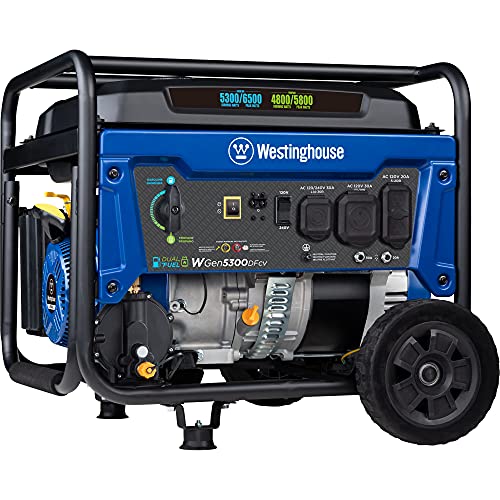
Westinghouse WGen5300DFcv
- Best for: Smaller homes, RV owners, and buyers who only need essential circuits covered.
- 6,500 peak watts and 5,300 running watts on gasoline
- 5,800 peak watts and 4,800 running watts on propane
- 274cc 4-stroke OHV engine with a cast iron sleeve
- Hour meter listed in the Amazon special features
Smaller homes, RV owners, and buyers who only need essential circuits covered.
The lower running watts mean a large air conditioner or electric water heater will not fit, so list the must-run appliances before choosing this size.
The WGen5300DFcv is the right size for essential circuits rather than a whole house. It delivers 5,300 running watts on gasoline and 4,800 on propane, which covers a refrigerator, lights, a sump pump, and small electronics, and its RV-ready outlet suits a travel trailer. The hour meter is listed among its special features, alongside a carbon monoxide sensor, automatic voltage regulation, and overload protection. A 4.7-gallon tank runs for up to 14.5 hours, and the 120/240V volt selector switch helps the owner match the output to the load.
Watch out for: The lower running watts mean a large air conditioner or electric water heater will not fit, so list the must-run appliances before choosing this size.
Which One Fits Your Situation
You need backup for a typical family home
Choose the Westinghouse WGen9500DF. Its 9,500 running watts on gasoline cover a refrigerator, a furnace blower, lights, and a well pump, and the remote start means it can be started from indoors. The digital hour meter keeps maintenance visible, and the transfer-switch-ready outlet suits a home panel connection. That combination covers the loads most families actually run during an outage, without paying for capacity they will not use.
You run heavy appliances at the same time
Choose the DuroMax XP13000EH. Its 10,500 running watts on gasoline give the most headroom in this group for a central air conditioner, a large well pump, or several heavy loads together. The hour meter, carbon monoxide sensor, and push-button start make a large machine easier to manage during a long outage. That headroom also helps when a motor starts while other appliances are already running.
You expect a long outage and hate refuelling at night
Choose the Westinghouse WGen11500DFc. Its 9.5-gallon tank runs for up to 19 hours on gasoline, and the VFT display shows lifetime hours so service is never a guess. With 11,500 running watts on gasoline, it also covers more circuits than the smaller models in this guide. The longer tank also means fewer trips outside in bad weather to refuel.
You only need the essentials, or you power an RV
Choose the Westinghouse WGen5300DFcv. Its 5,300 running watts on gasoline cover a refrigerator, lights, and small electronics, and the RV-ready outlet suits a travel trailer. The hour meter and carbon monoxide sensor give the same maintenance and safety tracking as the larger units, in a smaller package. It is also easier to store and move than the whole-home units above.
Common Mistakes
- Buying on peak watts alone, then finding that running watts cannot carry a fridge and a well pump together.
- Comparing runtime figures from different load levels, which makes a short-running generator look like a long-running one.
- Ignoring the hour meter until the first oil change is overdue, then guessing how many hours the engine has run.
- Storing gasoline for months without stabiliser, then blaming the generator when it will not start in an outage.
- Placing the generator near a door or window, where exhaust can drift indoors even when the unit seems far enough away.
Frequently Asked Questions
What does a runtime meter actually track?
A runtime meter, often called an hour meter, tracks how many hours the engine has run. Many displays also show voltage and frequency, and some keep a lifetime total rather than resetting after each use. Use the lifetime hours to time oil changes and service, and use the voltage and frequency readings to spot output problems before they affect connected appliances.
Is a dual fuel generator worth it if I only use gasoline?
Yes, because propane stores well and stays usable after months in a cylinder, while gasoline degrades and needs stabiliser. A dual fuel generator lets the owner switch to propane when gasoline is scarce, stale, or hard to find during a storm. The hour meter works the same on either fuel, so maintenance tracking does not change with the fuel choice.
How many watts do I need for home backup?
Add the running watts of everything that must run at the same time, then add the starting watts of the largest motor. A fridge, lights, and a furnace blower often fit within 5,300 running watts, while a well pump or air conditioner pushes the need toward 9,500 running watts. When the total is close to the limit, move up a size.
How often should I change the oil in a generator with an hour meter?
Follow the interval in the owner manual for the specific model, and use the hour meter to know when that interval arrives. A common pattern is an early first change after the break-in hours, followed by regular changes after a set number of running hours. Record the meter reading at each change, and check the oil level before every start, especially after long storage.
Related guides
More from Amazon
Programs that pair well with the guide above. Offers and eligibility are set by Amazon and may change.
Free shipping on eligible items, Prime Video and more. Eligible new members can start with a free trial.
Start a Prime free trialAudiobooks and podcasts to listen to on the go. Eligible new members can start with a free trial.
Try Audible freeAd-free music streaming. Eligible new subscribers can start with a free trial.
Try Music Unlimited freeA free business account with business pricing and bulk-buying tools for work, shop or home office.
Create a business accountAs an Amazon Associate we earn from qualifying purchases.



Write Your Review
No reviews yet. Be the first to share your experience!