
Key takeaways
- Compare five floor-standing drill presses for metalworking shops, with swing, low-speed range, spindle travel and chuck specs taken from each listing.
What's inside
As an Amazon Associate I earn from qualifying purchases. This post may contain affiliate links at no extra cost to you.
Buying a floor-standing drill press for a metalworking shop is really a decision about low-speed torque and rigidity. Large bits in steel need a spindle that turns slowly without stalling, and enough cast iron around it to keep holes round instead of chattered. Benchtop machines run out of swing, spindle travel, and stiffness long before they run out of advertised top speed, so the pedestal format is where serious metal drilling starts.


This guide serves small fabrication shops, repair and maintenance shops, and serious home metal shops choosing their first or next floor press. Every pick is a floor-standing model, and each one was chosen from the product name and listed specifications on its Amazon page: swing, speed range, spindle travel, chuck size, motor rating, and table dimensions, compared side by side below.
Quick Picks
As an Amazon Associate we earn from qualifying purchases
| Product | Best for | Key spec from title |
|---|---|---|
| JET JDP-20MF 20-Inch Floor Drill Press | Daily plate and structural work in a small fab shop | 20-inch swing, 1-1/2 HP motor |
| WEN 4227T 13-Amp 12-Speed Floor Standing Drill Press | Deep holes in thick stock on standard shop power | 13-amp motor, 4-3/4-inch spindle travel |
| JET JDP-17 17-Inch Floor Drill Press | Repetitive drilling with fast belt speed changes | 5-inch spindle travel, 16 speeds |
| Powermatic PM2800B 18-Inch Floor Drill Press | Mixed materials with constant speed adjustments | Variable speed 250 to 3,000 RPM, 1 HP |
| Shop Fox W1848 Oscillating Floor Drill Press | Tight floor space plus contour sanding between drilling jobs | Oscillating spindle, 13-3/4-inch swing |
How to Choose
Judge the slow end of the speed range, not the top
Steel decides this purchase. A half-inch bit in mild steel wants a spindle speed in the low hundreds of RPM, and annular cutters and hole saws want slower still. A press whose range bottoms out at 150 to 250 RPM, like several models here, can run those tools without burning edges or work-hardening the part. Top speed only matters for small bits in aluminum or plastics. Pair the low end with motor size: a 1-1/2 HP motor holds torque at crawl speeds in a way a smaller motor cannot, so check both numbers on the listing together rather than shopping by horsepower alone.
Match swing and drilling capacity to the parts you actually run
Swing is twice the distance from the spindle center to the column, and it sets the widest part you can center under the bit. A 20-inch swing swallows large plates and housings that a 13-3/4-inch machine physically cannot position. Drilling capacity in steel is the second check: it tells you the largest hole the maker rates the machine for in metal, which is always smaller than its capacity in wood. List the biggest parts and holes your shop genuinely sees each month, then buy one size above that. Oversizing wastes floor space and money; undersizing shows up the first time a wide flange lands on the table.
Count spindle travel and chuck-to-table room
Spindle travel is how deep the quill drills in one stroke. Four and three-quarter inches clears most plate and bracket work, while five or six inches lets you bore through thick bosses and stacked parts without raising the table or re-chucking mid-hole. Chuck-to-table distance matters just as much in a metal shop, because a drill press vise, parallels, and the part itself all stack up under the bit. Check the listed table size too: slotted cast iron tables accept vise and clamp setups, and a table that tilts helps with angled holes in fabricated assemblies.
Decide how you want to change speeds
Stepped-belt presses, including both JET models here, change speed by moving a belt on pulleys. It is simple, durable, and cheap to repair, but it interrupts the work, so operators tend to leave the belt where it is. The Powermatic’s mechanical variable speed adjusts with a dial while the machine runs, with no belt changes at all, which suits shops that swap between steel, aluminum, and plastic all day. One-handed belt tensioning narrows the gap on the JET JDP-17. Decide honestly how often your operators change bits and materials, then pick the system they will actually use.
The 5 Best Options
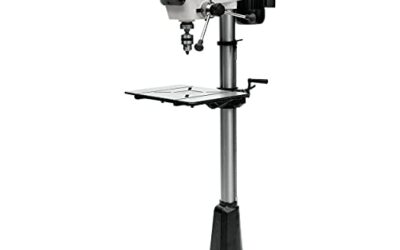
JET JDP-20MF 20-Inch Floor Drill Press
The JDP-20MF is the capacity pick for a metalworking shop that drills plate, angle, and housings every day. Its 20-inch swing is the largest here, the 1-1/2 HP motor is the strongest here, and the speed range starts at 150 RPM, which is where large bits in steel do their work. The 3/4-inch chuck grips bigger tooling than the 5/8-inch chucks on the rest of this list. Shops outgrowing a bench press and tired of farming out oversized drilling will feel the difference immediately, and the built-in work light and tilting table round out a machine aimed at production rather than occasional use.
Specs
- Motor: 1-1/2 HP, 115/230V
- Speeds: 12, from 150 to 4,200 RPM
- Swing: 20 inches
- Chuck size: 3/4 inch
- Table: tilting, with built-in work light
- Warranty: 2 years
Best for: Small fabrication shops drilling large steel parts daily
Watch out for: Confirm your circuit and voltage before ordering, and check the listing for the current spindle travel figure
ASIN: B00004T9L1
WEN 4227T 13-Amp 12-Speed Floor Standing Drill Press
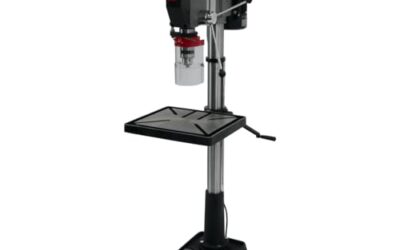
The 4227T brings floor-press capacity to shops that cannot justify a premium badge. The 13-amp motor drives 12 speeds starting at 150 RPM, so it turns large bits in steel at sensible speeds, and the 4-3/4 inches of spindle travel is deep enough to pass through thick stock in a single stroke. The 14 by 14-inch cast iron table pivots 45 degrees in both directions for angled work, and the laser pointer, onboard chuck key storage, and coolant runoff channel are small touches that suit metal drilling specifically. At 214 pounds it plants itself firmly once positioned.
Specs
- Motor: 13-amp
- Speeds: 12, from 150 to 3,150 RPM
- Swing: 17 inches
- Chuck: 5/8 inch, accepts bits from 1/16 to 5/8 inch
- Spindle travel: 4-3/4 inches
- Table: 14 x 14-inch cast iron, pivots 45 degrees each way
- Features: laser pointer, onboard key storage, coolant runoff channel
- Weight: 214 pounds
- Warranty: 2 years
Best for: Repair shops and home metal shops drilling thick stock on standard power
Watch out for: Speed changes are belt changes, so verify the belt access and tensioning arrangement suits your workflow
ASIN: B08ZVNHWK8
JET JDP-17 17-Inch Floor Drill Press
The JDP-17 is built around repetitive drilling. Its spindle travels a full five inches in one revolution of the handle, the longest stroke among the belt-driven models here, and one-handed belt tensioning makes its 16 speeds genuinely quick to change between. The 14 by 19-inch cast iron table gives metal parts and vises more support than the square tables on smaller presses, and the edge lip is designed to make clamping easier. An integrated LED work light and the Xacta-X laser help operators line up repeat holes, and JET backs the machine with a five-year warranty, the longest coverage in this group.
Specs
- Motor: 3/4 HP, 115V, 9-amp TEFC
- Speeds: 16, from 210 to 3,500 RPM
- Swing: 16-7/8 inches
- Spindle travel: 5 inches
- Chuck size: 5/8 inch
- Table: 14 x 19-inch cast iron, tilts 90 degrees left and right
- Drive: poly-v belt with one-handed belt tensioning
- Features: built-in LED work light, Xacta-X laser, depth stop
- Warranty: 5 years
Best for: Shops running batches of identical holes in brackets, plates, and fixtures
Watch out for: The motor is 3/4 HP, so confirm the listing’s rated drilling capacity in steel covers your largest regular bit
ASIN: B00NF6P8PI
Powermatic PM2800B 18-Inch Floor Drill Press

The PM2800B removes the belt from the speed equation entirely. Its mechanical variable speed drive adjusts from 250 to 3,000 RPM with a dial, and a digital readout shows the exact spindle speed, so operators set the correct RPM for each bit and material instead of settling for the nearest pulley step. Six inches of spindle travel is the deepest here, and the keyless chuck speeds up bit swaps. A fence system, adjustable material stop, laser guides, and two LED work lights all target repeatability. At 246 pounds on an oversized cast iron base, it is also the steadiest platform in this roundup.
Specs
- Motor: 1 HP, 115/230V, prewired 115V
- Speeds: mechanical variable, 250 to 3,000 RPM, no belt changes
- Swing: 18 inches
- Spindle travel: 6 inches
- Chuck: 5/8-inch keyless
- Table: 20 x 14-inch, tilts 0 to 90 degrees, with fence and material stop
- Features: digital RPM readout, laser guides, two LED work lights
- Weight: 246 pounds
- Warranty: 5 years
Best for: Mixed-material shops that change speeds and bits many times a day
Watch out for: It is the heaviest machine here, so plan the floor position and the move into the shop before it arrives
ASIN: B00EONQF1M
Shop Fox W1848 Oscillating Floor Drill Press

The W1848 is the floor press for shops where floor space is shared and parts need finishing as well as drilling. Its oscillating spindle converts the machine into a spindle sander without tools, and the included three-piece drum kit handles contour sanding and deburring on the same footprint. As a drill press it offers a 13-3/4-inch swing, 12 speeds from 250 to 3,050 RPM, and a table that tilts 90 degrees in both directions. The swing and chuck capacity are the smallest here, which is the honest trade for the second function, but for lighter metalwork and fabrication cleanup it covers two jobs with one machine.
Specs
- Motor: 3/4 HP, 110V
- Speeds: 12, from 250 to 3,050 RPM
- Swing: 13-3/4 inches
- Spindle travel: 3-1/4 inches
- Chuck capacity: 1/64 to 5/8 inch
- Table: tilts 90 degrees left and right, 2-inch dust port
- Features: oscillating spindle converts to sander, 3-piece sander drum kit included
- Overall height: 63 inches
- Warranty: 2 years
Best for: Small shops that drill lighter metalwork and also sand or deburr contoured parts
Watch out for: The 250 RPM minimum and 3/4 HP motor set a ceiling on bit size in steel, so check the listing’s steel capacity against your work
ASIN: B0742TSVKN
Which One Fits Your Situation
You drill plate and structural parts every day
Start with the JET JDP-20MF. The 20-inch swing centers wide parts the other machines cannot, the 1-1/2 HP motor holds torque at the 150 RPM bottom of its range, and the 3/4-inch chuck accepts the larger tooling that structural work uses. It is the only pick here sized for that workload without compromise.
Your shop runs on standard 115V power and a tight equipment budget
The WEN 4227T fits this situation. It delivers a 17-inch swing, a 150 RPM low speed for steel, and 4-3/4 inches of spindle travel from a 13-amp motor on ordinary shop power. You give up the premium brands’ warranty length and refinement, but the drilling envelope that matters for metal is fully present.
You run batches of identical holes
Choose between the JET JDP-17 and the Powermatic PM2800B. The JDP-17 pairs a five-inch stroke with a depth stop and one-handed belt tensioning for fast, repeatable cycles. The PM2800B adds a digital RPM readout and a material stop, and its six-inch travel handles deeper batch parts. Pick by how often speeds change between batches.
Your floor space is tight and parts need finishing too
The Shop Fox W1848 earns its footprint twice, drilling lighter metalwork and then converting to an oscillating spindle sander for contours and deburring. In a small shop where a separate sander would never fit, that second function is worth more than the swing and chuck capacity you trade away to get it.
Common Mistakes
- Shopping by maximum RPM when metal drilling is decided by the minimum speed and the torque behind it.
- Choosing swing from the largest part you can imagine instead of the largest part you actually drill each month.
- Ignoring spindle travel, then discovering mid-hole that the quill cannot finish a thick part in one stroke.
- Forgetting the vise: leaving no chuck-to-table room for the press vise, parallels, and part stacked together.
- Setting a 200-plus-pound machine in place without checking ceiling height, floor condition, and the circuit it will run on.
Frequently Asked Questions
What spindle speed do I need for drilling steel?
Larger bits in steel need low speeds, often in the low hundreds of RPM, which is why the bottom of the range matters more than the top. The presses here start between 150 and 250 RPM. Smaller bits in aluminum and plastic use the higher steps, so a wide overall range covers a mixed workload.
Why choose a floor-standing press over a benchtop model for metal?
A pedestal machine carries more mass, a longer column, and a bigger swing. That translates into less flex under drilling load, room for tall parts and a press vise under the chuck, and deeper spindle travel. For occasional small holes a bench model survives; for daily metal drilling the floor format is the durable choice.
What chuck size should a metalworking shop look for?
A 5/8-inch chuck, fitted to four of the five presses here, covers most jobber bits and reduced-shank tooling a small shop uses. If you regularly run larger bits or annular cutters with straight shanks, the 3/4-inch chuck on the JET JDP-20MF is the step up. Check the listing’s chuck and taper details before ordering.
Can a floor drill press handle tapping and reaming as well?
Yes, within limits. Low spindle speeds and a depth stop, both present on these models, suit reaming and hand-guided tapping with a tap guide. A standard drill press does not reverse under power like a tapping head, so production tapping still belongs on dedicated equipment; for occasional threads, the slow end of the range does the job.
Related guides
More from Amazon
Programs that pair well with the guide above. Offers and eligibility are set by Amazon and may change.
Free shipping on eligible items, Prime Video and more. Eligible new members can start with a free trial.
Start a Prime free trialAudiobooks and podcasts to listen to on the go. Eligible new members can start with a free trial.
Try Audible freeAd-free music streaming. Eligible new subscribers can start with a free trial.
Try Music Unlimited freeA free business account with business pricing and bulk-buying tools for work, shop or home office.
Create a business accountAs an Amazon Associate we earn from qualifying purchases.

Write Your Review
No reviews yet. Be the first to share your experience!