
Key takeaways
- Five floor-standing drill presses with depth stops, compared on swing, spindle travel, speeds and table size using only specs from their Amazon listings.
What's inside
As an Amazon Associate I earn from qualifying purchases. This post may contain affiliate links at no extra cost to you.
A depth stop is the difference between a floor drill press that earns its footprint and one that merely takes up room. The real buying decision is not swing or top speed; it is whether the machine can plunge to the same depth fifty times in a row without the setting creeping. Listings blur this point, because many presses advertise a depth scale or gauge that only shows travel, while a true stop physically halts the quill at a set point. This guide separates the two and favors positive stops you can lock down.


The five presses below suit woodworkers batch-drilling dowel and shelf-pin holes, fabricators repeating holes in brackets and plate, and small shops stepping up from a benchtop machine. Every pick is a floor-standing model whose listing or manufacturer specification names a depth stop, and each one is compared on swing, spindle travel, speeds and table size taken from its product page.
Quick Picks
As an Amazon Associate we earn from qualifying purchases.
| Product | Best for | Key spec from title |
|---|---|---|
| JET JDP-20MF 20-Inch Floor Drill Press (354170) | Heavy repeat work in steel and hardwood | 1/2-inch external depth stop with three-nut locking |
| JET JDP-17 17-Inch Floor Drill Press (716300) | Woodworking batches with long quill travel | Integrated depth stop with 5-inch spindle travel |
| WEN 4227 17-Inch 12-Speed Floor Standing Drill Press | First floor press on a tighter budget | Adjustable depth stop with 4-3/4-inch spindle travel |
| SHOP FOX W1680 17-Inch Floor Model Drill Press | Small shops that calibrate once and run batches | Fitted depth stop with calibrated scale |
| Delta 18-900L 18-Inch Laser Drill Press | Precision furniture work and zeroed depth settings | Micro-adjustable depth stops with independent depth scale |
How to Choose
Depth Stop Design: Locking Rod, Dial or Micro-Adjust
Stops come in three broad styles. An external threaded rod with jam nuts, like the three-nut setup on the JET JDP-20MF, is simple, visible and hard to knock out of adjustment. An integrated dial stop, as on the JET JDP-17, keeps the mechanism inside the head and suits frequent small changes. A micro-adjustable stop with its own scale, like the Delta’s, lets you dial in a depth and return to it later. Whichever style you pick, drill a test hole in scrap first and measure it, because a stop that slips under feed pressure is only a gauge.
Spindle Travel Versus Your Thickest Stock
Spindle travel decides how deep the bit can go in a single plunge, and the five presses here span 3-1/4 to 6 inches. Through-holes in 4×4 stock need close to 4-3/4 inches of travel once the bit point is counted, while blind holes for hardware rarely need more than 3 inches. Remember that chuck length and bit length eat into the clearance between the bit tip and the table, so a tall workpiece on the table may force you to swing the table aside and drill against the base instead. Match travel to your thickest regular job, not a rare one.
Speed Range and Motor for Wood and Metal
Large Forstner bits and holes in steel want the low end of the speed range, roughly a few hundred RPM or less, while small bits in softwood run happily at the top. Belt-stepped presses here offer 12 or 16 fixed speeds, so check that the steps include a genuinely slow setting near 150 to 210 RPM. Motor size runs from 3/4 HP on the lighter machines to 1-1/2 HP on the JET JDP-20MF, and the bigger motors hold speed better under a wide bit. Most of these presses run on a standard 115V circuit, which keeps installation simple.
Table, Base and Footprint
A floor press is only as steady as its base, so plan to bolt it to the floor or a heavy platform before judging its accuracy. Table size and tilt matter for clamping: a wide table with slots gives a fence and clamps somewhere to bite, and a table that tilts lets you drill angled holes without shimming the work. Rack-and-pinion table height adjustment saves your back when stock thickness changes often. These machines weigh roughly 185 to 280 pounds, so decide the final spot first, assemble the press there, and have a second person on hand for the head and column.
The 5 Best Options
JET JDP-20MF 20-Inch Floor Drill Press (354170)
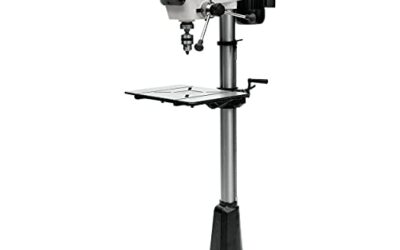
The JDP-20MF is the production pick of this group, built around a 20-inch swing and a 1-1/2 HP motor that keeps large bits turning in steel and dense hardwood. Its depth stop is the old-school kind many machinists prefer: a 1/2-inch external rod where one nut sets the depth and the remaining nuts lock it, so the setting stays put across a long run of identical holes. The 4-5/8 inches of spindle travel covers deep boring, the table measures 18-1/2 by 16 inches and tilts 45 degrees, and a built-in work light helps you see the layout line before you commit.
Specs
- Swing: 20 in
- Motor: 1-1/2 HP, 115/230V, 1 Ph (prewired 115V)
- Spindle speeds: 12 speeds, 150 to 4,200 RPM
- Spindle travel: 4-5/8 in
- Chuck: 3/4 in keyed
- Spindle taper: MT-3
- Depth stop: 1/2 in external depth stop with three-nut locking feature
- Table: 18-1/2 x 16 in, tilts 45 degrees
- Drilling capacity: 1 in in cast iron, 3/4 in in mild steel
- Warranty: 2 years
Best for: Fabrication and production shops repeating holes in steel plate, brackets and hardwood parts.
Watch out for: The work lamp bulb is sold separately, and this is a heavy machine, so plan on two people, a clear path and a fixed spot before delivery day.
JET JDP-17 17-Inch Floor Drill Press (716300)
The JDP-17 leans toward woodworking, pairing an integrated depth stop with a full 5 inches of spindle travel, the second-longest stroke in this group. JET’s one-handed belt tensioning makes the 16 speeds practical to use rather than theoretical, since swapping speeds is quick enough that you will actually do it. The 14 by 19 inch table tilts 90 degrees left and right and carries a replaceable MDF insert, so a bit that punches through the work damages a cheap insert instead of the cast iron. An Xacta-X laser and a built-in LED work light round out the setup.
Specs
- Swing: 16-7/8 in
- Motor: 3/4 HP, 115V, 1 Ph, 9 amps
- Spindle speeds: 16 speeds, 210 to 3,500 RPM
- Spindle travel: 5 in
- Chuck: 5/8 in
- Depth stop: Integrated depth stop
- Table: 14 x 19 in, tilts 90 degrees left and right
- Extras: Xacta-X laser system, built-in LED work light, replaceable MDF table insert
- Weight: 187 lb
- Warranty: 5 years
Best for: Woodworkers batch-drilling dowel joints, mortise layouts and shelf-pin holes at repeatable depths.
Watch out for: A small pilot light stays lit whenever the press is plugged in, and speed changes still mean moving a belt, even with the one-handed tensioner.
WEN 4227 17-Inch 12-Speed Floor Standing Drill Press

The WEN 4227 is the value route into floor-standing capacity, with a 17-inch swing, a 13-amp motor and 4-3/4 inches of spindle travel that handles through-holes in thick stock without repositioning the work. The adjustable depth stop works with the machine’s depth scale for repeat blind holes, and the 14 by 14 inch cast iron table pivots 45 degrees in both directions for angled work. A precision laser helps you line up the bit with your mark, and the table includes a channel to catch coolant runoff during metal work. For a first floor press in a home or small shop, it covers the essentials.
Specs
- Swing: 17 in
- Motor: 13 amp, 120V
- Spindle speeds: 12 speeds, 180 to 2,940 RPM
- Spindle travel: 4-3/4 in
- Chuck: 5/8 in keyed
- Table: 14 x 14 in cast iron, pivots 45 degrees in both directions
- Depth stop: Adjustable depth stop with depth scale
- Extras: Precision laser, work light, onboard chuck key storage
- Weight: 214 lb
- Warranty: 2 years
Best for: First-time floor-press buyers who need 17-inch swing and deep travel for mixed wood and light metal work.
Watch out for: WEN also sells an updated 4227T version of this press, so confirm the exact model name on the listing before ordering.
SHOP FOX W1680 17-Inch Floor Model Drill Press

The W1680 suits small cabinet and machine shops that set a depth once and then run a batch. Its fitted depth stop works with a calibrated scale, and the current manual includes dedicated steps for calibrating and adjusting the stop, which makes returning to a known setting a documented procedure rather than guesswork. The 1 HP motor turns 12 speeds down to a slow 140 RPM for larger bits, the round 14-inch table tilts for angled holes, and a built-in light socket supports a work light. At 66 inches tall it keeps a full floor-press stance without the bulk of the 20-inch machines.
Specs
- Swing: 17 in
- Motor: 1 HP, 110V, 1 Ph
- Spindle speeds: 12 speeds, 140 to 3,050 RPM
- Spindle travel: 3-1/4 in
- Chuck: 5/8 in
- Table: 14 in diameter, tilting
- Depth stop: Fitted depth stop with calibrated scale
- Overall height: 66 in
- Weight: 185 lb
Best for: Small cabinet and machine shops that calibrate the stop once and run repeated batches all week.
Watch out for: The 3-1/4-inch spindle travel is the shortest here, so deep through-holes in thick stock may need the work raised on blocks or drilled in two passes.
Delta 18-900L 18-Inch Laser Drill Press
The 18-900L is the precision woodworker’s option. Its micro-adjustable depth stops pair with an independent depth scale that you can zero out, so a batch depth can be set, recorded and returned to without trial holes. The 6-inch quill stroke is the longest in this group, which helps when boring deep mortises or drilling tall workpieces. A twin laser projects a crosshair at the bit point, the auto-tensioning belt drive keeps speed changes simple across 16 speeds, and the oversized cast iron table tilts 90 degrees left and right and forward, which suits the compound angles common in chair making.
Specs
- Swing: 18 in
- Motor: 3/4 HP, 120V
- Spindle speeds: 16 speeds, 170 to 3,000 RPM
- Spindle travel: 6 in
- Chuck: 5/8 in
- Depth stop: Micro-adjustable depth stops with independent depth scale
- Table: Oversized cast iron, tilts 90 degrees left and right and forward for compound angles
- Extras: Twin laser crosshair, auto-tensioning belt drive system
Best for: Furniture and chair makers who zero the depth scale for each batch and drill angled or deep work.
Watch out for: This is an older Delta model, so check the seller and the warranty terms shown on the listing carefully before ordering.
Safety Checks Before You Drill
A depth stop only protects your workpiece; the habits below protect you. Clamp every workpiece to the table or hold it in a drill press vise, and never hold stock by hand, because a bit that grabs will spin the piece faster than you can react. Remove the chuck key before starting the motor, every time, and keep the belt guard closed while the spindle turns. Keep gloves, loose sleeves, jewelry and long hair away from the rotating chuck and bit, and wear eye protection. Set and test the depth stop with the spindle off, confirm the bit cannot reach the table or fence at full plunge, and let the spindle stop completely before measuring a test hole or changing the setting. Unplug the press before changing belts or speeds that require opening the head.
Which One Fits Your Situation
Batch Holes in Steel Brackets and Plate
Choose the JET JDP-20MF. Its 1-1/2 HP motor, 3/4-inch chuck and external three-nut depth stop are built for repeated holes in metal, where feed pressure is higher and a stop that creeps costs you parts. The slow 150 RPM bottom speed also suits larger bits in steel, and the wide table gives clamps and a vise room to work.
Furniture Work With Lots of Repeat Depths
Choose the JET JDP-17. Dowel joints, shelf-pin rows and hardware cups all live or die on consistent depth, and the integrated stop plus 5 inches of travel handle them without fuss. The large tilting table and replaceable insert make it the most woodworking-friendly setup here, and the five-year warranty is the longest of the group.
Your First Floor Press in a Home Shop
Start with the WEN 4227. It delivers genuine floor-press numbers, a 17-inch swing and 4-3/4 inches of travel, at the lowest commitment in this group, and its depth stop and laser cover the features a first-time owner will actually use. If your floor space is tighter and your work is mostly cabinet parts, the SHOP FOX W1680 is the smaller alternative to compare.
Fine Furniture and Angled Chair Work
Choose the Delta 18-900L. Chair and stool work mixes deep boring with compound angles, and this press answers with the longest stroke here, micro-adjustable stops you can zero for each batch, and a table that tilts forward as well as sideways. The twin laser helps place holes on angled parts where a pencil mark is hard to read.
Common Mistakes
- Buying a benchtop press because the swing number looks similar, then finding the table too small and the travel too short for real floor-press work.
- Trusting a depth scale or gauge instead of a positive stop, so vibration and feed pressure let the depth creep across a batch.
- Setting the stop without counting the drill bit’s pointed tip, which makes every hole deeper than planned and can drive the bit into the table.
- Skipping the base bolts, so the tall, top-heavy machine vibrates or rocks and quietly ruins the repeatability you bought it for.
- Leaving the chuck key in the chuck or holding small parts by hand instead of clamping them.
Frequently Asked Questions
What is the difference between a depth stop and a depth scale?
A depth scale only shows how far the quill has traveled; it stops nothing. A depth stop is a physical limit, usually a rod with lock nuts, a dial mechanism or a micro-adjust collar, that halts the quill at the same point on every plunge. For batches of identical blind holes, the stop is what guarantees consistency, while the scale just helps you set it.
How do I set a depth stop for a batch of identical holes?
Lower the bit, with the motor off, until its tip touches a gauge block or the measured depth mark on your workpiece, then run the stop nuts or dial down to the contact point and lock them. Drill one hole in scrap the same thickness as your work, measure it, and nudge the stop if needed. Once the test hole measures right, the rest of the batch follows.
How much spindle travel do I need for through-holes in thick stock?
Plan on travel at least equal to the stock thickness plus the length of the bit’s pointed tip, with a little extra so the bit clears the far side cleanly. For 4×4 stock that means roughly 4-3/4 inches or more, which the WEN 4227, JET JDP-17 and Delta 18-900L provide. With a shorter-travel press, raise the work or drill from both sides instead.
Can these floor drill presses drill metal as well as wood?
Yes, within their capacity. Each press here lists speeds low enough for steel with the right bit and cutting fluid, and the JET JDP-20MF is rated for 3/4-inch holes in mild steel. The limits are rigidity and motor size: a 3/4 HP woodworking-leaning press will drill steel slowly and in smaller diameters, while the heavier machines handle metal work as a routine job.
Related guides
More from Amazon
Programs that pair well with the guide above. Offers and eligibility are set by Amazon and may change.
Free shipping on eligible items, Prime Video and more. Eligible new members can start with a free trial.
Start a Prime free trialAudiobooks and podcasts to listen to on the go. Eligible new members can start with a free trial.
Try Audible freeAd-free music streaming. Eligible new subscribers can start with a free trial.
Try Music Unlimited freeA free business account with business pricing and bulk-buying tools for work, shop or home office.
Create a business accountAs an Amazon Associate we earn from qualifying purchases.

Write Your Review
No reviews yet. Be the first to share your experience!