
Key takeaways
- Compare pulse TIG welders with digital displays on pulse range, memory presets, AC/DC output and duty cycle, with picks for thin metal and aluminum.
What's inside
As an Amazon Associate I earn from qualifying purchases. This post may contain affiliate links at no extra cost to you.
As an Amazon Associate we earn from qualifying purchases
Best Pulse TIG Welders With Digital Displays for Control
Pulse TIG welding earns its keep on thin material: by cycling the arc between a peak current and a lower background current many times per second, the puddle gets enough heat to fuse without soaking the part long enough to warp it or blow through. The catch is that pulse only helps when you can set it precisely and repeat those settings tomorrow. That is where the display comes in. The best pulse TIG welders with digital displays show your amperage, pulse frequency, pulse width and mode on a readout instead of asking you to guess where a knob landed, and the better machines store complete setups in memory presets you can recall in seconds.
This guide compares five AC/DC pulse TIG welders sold on Amazon US that pair a real pulse function with a digital display. They range from a lightweight dual-voltage 200-amp unit you can run from a household outlet to a 250-amp digital machine with nine memory channels and pulse rates up to 500 Hz. Every pick welds aluminum on AC and steel or stainless on DC, and every specification below comes from the manufacturer or the Amazon listing for that exact model.
Quick Picks
| Product | Best for | Key spec |
|---|---|---|
| Everlast PowerTIG 255EXT | Deepest digital control and presets | DC pulse 0.1-500 Hz, 9 memory programs |
| YESWELDER TIG-200P ACDC | Lightweight dual-voltage work | 200A, large LED display, auto memory |
| Weldpro 200A AC/DC TIG Welder | Complete starter package | Pulse 0.5-200 Hz, foot pedal included |
| PrimeWeld TIG225X | Knob lovers who want a digital amp readout | 225A, digital amperage display, CK17 torch |
| YESWELDER TIG-250P AC/DC | Most output on 220V input | 250A TIG, 60% duty cycle at full output |
How to Choose the Best Pulse TIG Welders With Digital Displays
Pulse frequency and pulse width are the settings that matter most
Pulse frequency is measured in pulses per second (Hz). Low settings around 0.5-2 Hz give you a visible rhythm that helps time your filler dabs on thicker sections. High settings, from about 100 Hz upward, constrict the arc and concentrate heat, which stiffens the puddle on thin sheet and tightens the bead on stainless exhaust and intercooler piping. Pulse width (also called pulse time on or peak time) sets what share of each cycle is spent at peak current, and the background current sets how far the arc drops between pulses. A wide, useful pulse range is roughly 0.5 Hz at the low end to at least 200 Hz at the top; machines that reach 500 Hz on DC give you the tightest arc control of all. Check that all three values — frequency, width and background amps — are adjustable, not fixed behind a single pulse button.
Read what the display actually displays
Not every digital display shows the same thing. At the simple end, a single LED readout shows amperage only, and every other parameter is set with a knob whose position you judge by eye. That is workable and glove-friendly, but repeatability depends on your notes. Full digital panels show each parameter as you adjust it — pre-flow, start amps, up slope, peak and background current, pulse frequency, AC balance, down slope, end amps and post-flow — so the number on screen is the number the machine runs. If you switch between materials and thicknesses all day, a panel that displays every value is worth more than raw amperage.
Memory presets turn one-off settings into repeatable setups
A memory preset stores a complete parameter set: mode, amperage, pulse values, slopes and gas times. Shops that repeat jobs — the same thin-wall tubing, the same aluminum bracket — save each setup once and recall it instead of rebuilding it from scratch. Some machines go further and automatically restore your last settings after a power cycle, which is a smaller but still useful form of memory. If you only weld one material at one thickness, presets are a convenience. If you bounce between thin stainless, mild steel and aluminum in a single session, they are the feature that keeps your settings consistent.
AC output is for aluminum, DC is for almost everything else
Aluminum forms an oxide layer that has to be broken up during welding, and alternating current does that cleaning work on one half of each cycle while penetrating on the other. Any machine in this class must offer AC TIG if aluminum is on your list, and adjustable AC frequency (commonly 20-250 Hz) plus AC balance let you narrow the arc and control the cleaning width. Steel, stainless steel, chrome-moly and titanium weld on DC, where a low minimum amperage — 3 to 5 amps on the better machines here — decides how thin you can go without blowing holes. A DC-only pulse TIG welder can be excellent value for steel-only work, but it will never weld aluminum properly, so it does not belong in this comparison.
Duty cycle tells you how long full output lasts
Duty cycle is the share of a ten-minute period a machine can weld at a stated amperage before it needs to cool. Sixty percent at maximum output is commercial-grade territory; 40 percent at maximum is typical of value machines and still fine for fabrication work with natural pauses. Compare duty cycle at the amperage you will actually use, and remember that dual-voltage machines deliver their headline output on 220-240V input — on a 110-120V outlet the ceiling drops, sometimes to little more than half.
Start type and pedal control round out the package
High-frequency (HF) start strikes the arc without touching the tungsten to the work, which keeps the tungsten clean and the weld free of inclusions; every machine here has it. A foot pedal lets you feather amperage mid-weld, which matters on thin material and at the end of a bead. Some of these welders include the pedal in the box and some treat it as an add-on, so check the package contents against what your work needs.
The Picks in Detail
Everlast PowerTIG 255EXT

The 255EXT is the most digitally complete machine in this group. Its microprocessor-controlled panel drives a digital display, and it stores up to nine full programs in memory, so a setup for thin aluminum sheet and another for stainless tubing are each one recall away. Pulse control is the widest here: DC pulse runs from 0.1 to 500 Hz, standard AC pulse from 0.1 to 250 Hz, and an additional advanced AC pulse mode (0.1 to 10 Hz) alternates between AC and DC polarity for fast-freeze control on thin aluminum and deeper penetration on thick plate. Output reaches 255 amps on 240V input, with DC starting as low as 3 amps, and the TIG duty cycle is rated at 60 percent at 250 amps. Four AC waveforms — advanced square, soft square, triangular and sine — plus AC frequency adjustable from 20 to 250 Hz give it the deepest aluminum tuning in this roundup. It is also the heaviest machine here at about 62 pounds, and it carries Everlast’s five-year parts and labor warranty.
- Strength: Widest pulse range and true memory presets; the display shows the full parameter set, and 60 percent duty cycle at 250 amps supports long runs.
- Trade-off: Size and weight make it a bench machine rather than a portable one, and the deep menu takes time to learn.
- Skip it if you need a welder you can carry to the work with one hand, or your welding is simple enough that nine presets would never be used.
YESWELDER TIG-200P ACDC

This is the portability pick. At 7.47 kg (about 16.5 lb) for the machine, the TIG-200P ACDC is by far the lightest welder here, yet it still covers seven modes: AC TIG, DC TIG, AC pulse TIG, DC pulse TIG, MIX TIG, spot welding and stick. A large LED display shows the active parameters, and the auto memory function saves your settings and restores them after power-off, so the machine comes back the way you left it even though it has no numbered preset channels. Output tops out at 200 amps on 220V, with auto-sensing dual voltage (110V/220V) for household outlets at reduced output. High-frequency start, software-controlled square, triangle and sine AC waveforms, and an included WP-26 torch round out a package aimed at mobile repair and small-shop aluminum work.
- Strength: Full AC/DC pulse capability and a clear LED display in the lightest chassis here; auto memory removes the daily re-setup chore.
- Trade-off: The 200-amp ceiling and reduced output on 110V limit thick-section work, and settings memory is last-used only rather than multiple stored programs.
- Skip it if your work is mostly quarter-inch and thicker plate, or you need several distinct saved programs for repeat production jobs.
Weldpro 200A AC/DC TIG Welder with Pulse
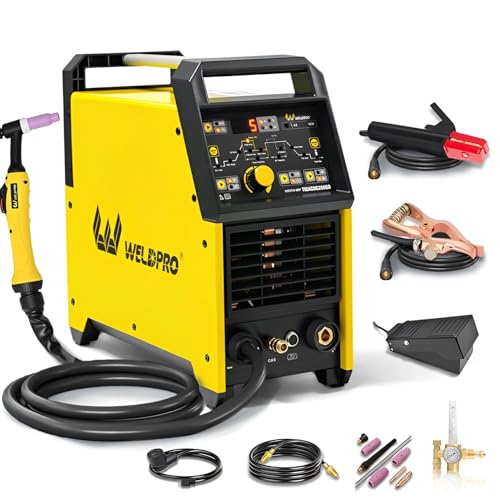
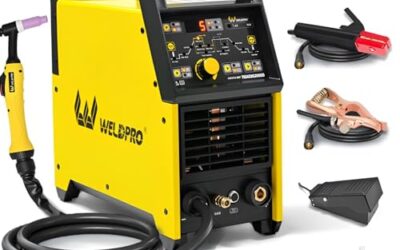
Weldpro’s 200-amp machine runs a digital menu system with an LED display that confirms amperage and mode before you strike an arc — genuinely useful when you are switching between AC TIG, DC TIG, AC pulse, DC pulse and stick in one session. Pulse frequency adjusts from 0.5 to 200 Hz, DC TIG starts at 5 amps for thin work, and AC TIG runs from 10 to 200 amps for aluminum. The package is the most complete starter kit here: a CK17 TIG torch, a foot pedal, a flow meter, gas hose, electrode holder, ground clamp and a consumables kit are all in the box. The trade-offs are a 40 percent duty cycle at 200 amps, which asks for cooling pauses during long full-power runs, and a settings menu that takes some learning before it feels fast. A three-year warranty covers the power source, and the machine weighs about 31 pounds.
- Strength: Digital display plus pulse to 200 Hz, with the torch, pedal and flow meter included — nothing essential left to buy before welding.
- Trade-off: Duty cycle is the lowest in this group at full output, and the menu-driven panel is slower to adjust with gloves on than dedicated knobs.
- Skip it if you plan long, continuous welds near 200 amps, or you want MIG and flux-core processes in the same machine — this is a TIG and stick unit only.
PrimeWeld TIG225X

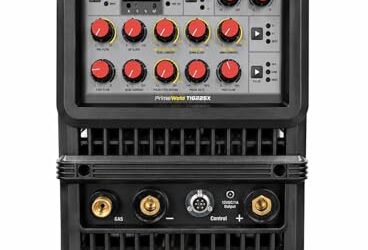
The TIG225X takes a hybrid approach: a digital display shows welding amperage, and every other parameter gets its own dedicated knob — twelve of them, covering start and end amps, up and down slope, pre-flow and post-flow, base current, pulse duty and AC frequency from 40 to 200 Hz. Pulse frequency runs from 0.5 to 200 Hz, output reaches 225 amps on 240V (with a 40 percent duty cycle at maximum and 100 percent at 155 amps), and the Amazon package pairs the machine with a CK17 flex-head torch. For welders who adjust by feel and glance at the amp readout to confirm, this layout is faster than any menu. The honest limitation is repeatability: with no memory presets and no numeric readout for the knob-set values, returning to an exact earlier setup means marking knob positions or keeping written notes. It weighs about 41 pounds and carries a three-year warranty.
- Strength: Highest output of the 200-class machines here, a clear digital amperage display, and glove-friendly knobs for every parameter.
- Trade-off: The display covers amperage only, and there are no memory presets, so repeat setups rely on your own records.
- Skip it if you need to recall exact multi-parameter setups between jobs, or you prefer to see every value as a number while you adjust it.
YESWELDER TIG-250P AC/DC

The TIG-250P is the output pick for shops with 220V power. It delivers 250 amps of TIG output (starting as low as 5 amps) at a 60 percent duty cycle, the strongest full-power endurance figure among the value-priced machines here. The front panel uses a digital display with parameter indicators and a single adjustment knob, and the machine automatically saves your parameters so the last setup returns at power-on. Six modes cover AC TIG, AC pulse TIG, DC TIG, DC pulse TIG, stick and spot welding, with full control over pre-flow, start current, up and down slope, finish current and post-flow. The box includes both a WP-26 torch and a WP-9 spot torch. The limits are clear: it runs on 220V only, so there is no household-outlet fallback, and at about 35 pounds it is a cart machine rather than a carry machine. A three-year warranty is included.
- Strength: Most TIG output here on a value chassis, with a digital display, full slope and gas control, and automatic saving of your last setup.
- Trade-off: 220V-only input rules out standard household outlets, and the single-knob interface steps through parameters one at a time.
- Skip it if your workspace only has 110V power, or you regularly weld in places where you cannot count on a 220V circuit.
Which One Fits Your Situation
You repeat the same jobs and want your settings back instantly
Choose the Everlast PowerTIG 255EXT. Nine memory programs hold complete setups, the display confirms every value, and the 500 Hz DC pulse ceiling gives thin stainless work the tightest arc control in this group.
You weld aluminum in a small shop or garage on mixed power
Choose the YESWELDER TIG-200P ACDC if portability matters — it is light enough to move between bench and job site, runs on either voltage, and its LED display and auto memory keep setup quick. Choose the Weldpro 200A if you would rather have the foot pedal and flow meter included from day one and can accept the lower duty cycle.
You weld thick sections and long beads on 220V power
Choose the YESWELDER TIG-250P AC/DC. Its 250-amp output and 60 percent duty cycle at full power are built for sustained work, and the digital display keeps the parameter set visible while you move through the panel.
You think in knobs, not menus
Choose the PrimeWeld TIG225X. Every parameter has a dedicated control, the digital readout confirms your amperage, and the CK17 flex torch package suits bench fabrication on steel and aluminum alike.
Common Mistakes
- Buying a DC-only pulse machine for aluminum. Pulse does not substitute for AC output. Without AC TIG and its cleaning action, aluminum welds come out contaminated no matter how good the pulse control is.
- Judging a display by size instead of content. A large readout that only shows amperage tells you less than a smaller full-parameter display. Check which values the screen actually presents before you buy.
- Chasing maximum pulse frequency and ignoring pulse width. Frequency alone does not control heat. You need adjustable peak time and background current as well, or the pulse feature is mostly decorative.
- Ignoring duty cycle at your real amperage. A machine rated 40 percent at maximum output is fine if you weld at 60 percent of its range, and limiting if you live at the top of the dial.
- Forgetting that dual voltage means reduced output. The headline amperage applies to 220-240V input. On a household outlet, expect a much lower ceiling and plan material thickness around it.
- Skipping the pedal check. Thin-material pulse work benefits from feathering amperage with a foot pedal. Confirm whether the pedal is included, supported or an extra purchase for the exact package you are ordering.
FAQ
What pulse frequency should I use for thin stainless steel?
Higher frequencies, roughly 100 Hz and above, constrict the arc and limit heat spread, which helps on thin stainless sheet and tubing. Lower frequencies around 1 Hz give a slower, visible pulse that many welders prefer for timing filler additions on thicker sections. The right answer is the one your machine lets you dial in and see on the display, which is why an adjustable range matters more than any single number.
Does a digital display make a TIG welder weld better?
The display does not change the arc; it changes how accurately and repeatably you can set the machine. Seeing exact values for amperage, pulse frequency and AC balance — and recalling them from memory presets — removes guesswork when you return to a job or switch materials, and that consistency shows up in the welds.
Can these welders run on a household outlet?
The dual-voltage machines here — the Everlast 255EXT, YESWELDER TIG-200P ACDC, Weldpro 200A and PrimeWeld TIG225X — run on 110-120V with reduced maximum output. The YESWELDER TIG-250P is 220V only. For thin material, household power is often enough; for thick sections, use the higher voltage.
What is the difference between AC pulse and DC pulse?
DC pulse cycles between peak and background current on direct current and is used on steel, stainless and other DC metals to control heat input. AC pulse applies the same cycling to alternating current for aluminum, combining oxide cleaning with reduced heat. Machines that offer both, like every pick in this guide, cover the widest range of work.
How much memory do I need in a welder?
One saved setup per recurring job is the practical rule. If you run two or three repeat jobs, a machine with a handful of presets — or one that restores your last settings automatically — covers you. If you only ever weld one material at one thickness, memory is a convenience you may never open.
Related guides
More from Amazon
Programs that pair well with the guide above. Offers and eligibility are set by Amazon and may change.
Free shipping on eligible items, Prime Video and more. Eligible new members can start with a free trial.
Start a Prime free trialAudiobooks and podcasts to listen to on the go. Eligible new members can start with a free trial.
Try Audible freeAd-free music streaming. Eligible new subscribers can start with a free trial.
Try Music Unlimited freeA free business account with business pricing and bulk-buying tools for work, shop or home office.
Create a business accountAs an Amazon Associate we earn from qualifying purchases.



Write Your Review
No reviews yet. Be the first to share your experience!