
Key takeaways
- Three pulse TIG welders compared on AC output, pulse adjustment range, input voltage and torch package, with the figures each Amazon listing states.
What's inside
As an Amazon Associate I earn from qualifying purchases. This post may contain affiliate links at no extra cost to you.
Choosing a pulse TIG welder comes down to how much control you need over the arc. Pulse settings let the machine alternate between a peak and a background current, which helps manage heat on thin sheet, tubing and detailed joints. The real decision is matching that control to your work: AC output for aluminum, enough adjustment range to matter, and an input voltage your shop wiring can actually supply. Amps alone will not tell you which one welds your jobs best.
The three machines below suit different buyers: home fabricators who want deep pulse adjustment, small shops that move between 110V and 220V outlets, and welders who need the highest output with spot welding in the same box. Each pick was chosen from the names and specifications published on its Amazon product page, so the figures quoted here are the ones the listings themselves state. A note on naming: one machine here recently changed its model suffix, and the listing’s current name is the one used throughout.
Quick Picks
As an Amazon Associate we earn from qualifying purchases
| Product | Best for | Key spec from title |
|---|---|---|
| PrimeWeld TIG225X | Deep pulse and AC adjustment | 225 Amp AC/DC with pulse, CK17 flex torch |
| AHP Alpha-TIG 225Xi | Running on 110V or 220V | Dual voltage, 200 Amp AC/DC pulse TIG |
| YESWELDER TIG-250P | Maximum output and spot welding | 250 Amp 6-in-1, 220V only |
How to Choose
AC Output Decides Whether Aluminum Is on the Table
Aluminum work settles the first question. The oxide skin on aluminum melts at a far higher temperature than the metal under it, and AC output cleans that layer away as you weld, which is why every machine in this roundup pairs AC with DC rather than offering DC alone. If your projects are steel and stainless only, DC pulse still earns its place for heat control. If aluminum is even an occasional job, treat AC as non-negotiable and look next at how much AC adjustment the machine exposes, since balance and frequency shape the arc as much as amperage does. That is also why DC-only bargains disappoint aluminum buyers within the first week.
Pulse Adjustment Range Matters More Than the Pulse Label
A pulse badge on the front panel tells you little by itself. What counts is the adjustment behind it: how wide the pulse time-on range runs, whether start and end amps can be set independently, and how the slope controls behave at the beginning and end of a weld. The PrimeWeld listing, for example, publishes a pulse time-on span from 10 to 90 percent alongside separate up-slope and down-slope timing, which gives thin work a gentle start and a tapered finish. A machine with one fixed pulse program cannot be tuned the same way, so compare the published ranges before anything else. Two machines can both claim pulse and behave nothing alike on thin stock.
Input Voltage Has to Match Your Shop Wiring
Pulse TIG machines split into two camps on power. Dual-voltage models such as the AHP below run on 110V or 220V, so they can work from an ordinary outlet at a gentler pace or a dedicated circuit at full output. The YESWELDER in this roundup is 220V only, full stop: there is no household-outlet fallback, and its section below says so plainly. Before ordering, check the breaker and receptacle where the machine will live, and remember that an adapter lead cannot create capacity your panel does not have. Voltage is a boring specification right up until the machine arrives and will not run. If the answer is a shared garage outlet, the shortlist writes itself.
What Arrives in the Box Changes the Real Cost
Two welders with identical headline amps can leave you with very different extra shopping lists. Read the listing for the torch package: the PrimeWeld ships with a CK17 flex torch and cable, while the YESWELDER adds a second, smaller WP-9 torch dedicated to spot welding next to its WP-26. Torch control modes matter as well, because 2T and 4T operation change how the arc starts and stops on long seams. Consumables, a regulator and a foot control may sit outside the box, so count the whole setup before deciding which machine is complete for your bench. A missing second torch or control mode is a real cost in time, even when the headline specification matches.
The 3 Best Options
PrimeWeld TIG225X

The TIG225X is the control-focused pick of the three. Its listing publishes the deepest adjustment figures: pulse time on from 10 to 90 percent, AC balance from 30 to 70 percent, and AC frequency from 40 to 200 Hz, with start and end amps adjustable across the 10 to 225 range. That spread suits welders who move between thin aluminum panels and heavier steel brackets in the same week. Slopes run from 0 to 10 seconds up and 0 to 25 seconds down, so starts and stops can be softened instead of abrupt. The package includes a CK17 flex torch and cable, and the machine carries a 3-year warranty.
Specs
- Output: 225 Amp IGBT inverter
- Processes: AC/DC TIG and stick, with pulse
- Start and end amps: 10 to 225 with pulse
- Pulse time on: 10 to 90 percent
- AC balance: 30 to 70 percent
- AC frequency: 40 to 200 Hz
- Gas timing: pre-flow 0.1 to 1 second, post flow 1 to 10 seconds
- Slope: up slope 0 to 10 seconds, down slope 0 to 25 seconds
- Torch control: 2T and 4T
- Included: CK17 flex torch and cable
- Warranty: 3 years
Best for: Welders who tune pulse and AC settings for each job, from thin aluminum sheet to steel brackets.
Watch out for: This brand sells mainly through its own store, so confirm the current offer on the Amazon listing before you order.
ASIN: B07BXHRBQ8
AHP Alpha-TIG 225Xi
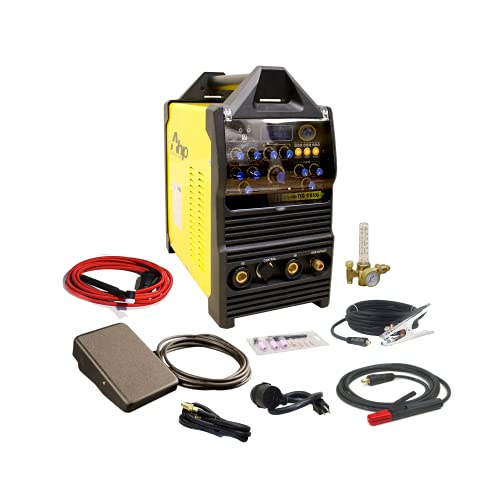
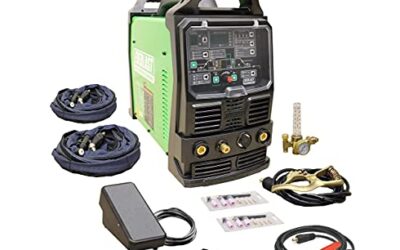
The Alpha-TIG 225Xi makes its case on flexibility of supply rather than published adjustment depth. Its listing title describes a 200 Amp IGBT inverter covering AC and DC pulse TIG plus stick welding, and it runs on dual voltage, 110V or 220V, which lets the same machine work in garages and workshops with different outlet types. AHP sells it as the current model, the 225Xi. Dual voltage also means a generator or borrowed workshop supply is less likely to leave it idle. Buyers comparing published pulse ranges line by line should read the full listing: the headline figures are what the title states, and nothing more is claimed here.
Specs
- Output: 200 Amp, as stated in the listing title
- Processes: AC/DC pulse TIG and stick
- Inverter: IGBT
- Input: dual voltage 110V/220V
- Model: Alpha-TIG 225Xi, the current model name
Best for: Welders who need one machine that can run on either a 110V or a 220V supply.
Watch out for: The listing title carries the headline figures only, so check the full product page for detailed pulse ranges before ordering.
ASIN: B096L9Y57J
YESWELDER TIG-250P

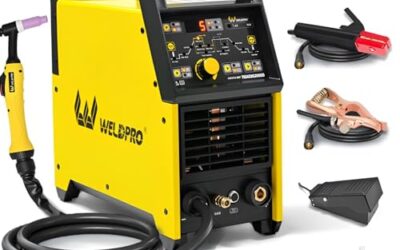
The TIG-250P is the output leader here, at 250 Amp, and it folds six functions into one digital inverter: AC TIG, DC TIG, both with pulse, stick welding and spot welding. Two torches come in the package, a WP-26 for general TIG work and a WP-9 dedicated to spot welding, which saves a separate purchase for repair work. At 34.9 pounds it is still a bench machine you can carry between bays without a cart. One limit needs stating plainly: this machine runs on 220V only. There is no 110V mode, so it belongs in a shop that already has the circuit to feed it.
Specs
- Output: 250 Amp digital inverter
- Processes: 6-in-1 — AC TIG, DC TIG, AC pulse TIG, DC pulse TIG, stick and spot welding
- Input: 220V only
- Included torches: WP-26 TIG torch and WP-9 spot TIG torch
- Model number: TIG-250P ACDC
- Weight: 34.9 lb
- Protection: IP21S, fan cooled
Best for: Shops with a 220V circuit that want maximum output plus spot welding in one machine.
Watch out for: It cannot run on a 110V outlet at all, so confirm your circuit can feed it before ordering.
ASIN: B08CBD1L69
Which One Fits Your Situation
Thin Aluminum Panels and Signage Work
Pick the PrimeWeld TIG225X. Aluminum rewards control, and this listing publishes the widest AC adjustment of the three: balance from 30 to 70 percent and frequency from 40 to 200 Hz, plus pulse time on up to 90 percent. Those ranges let you narrow the arc for crisp edges on sheet or widen the cleaning action on cast pieces, then taper the finish with the down-slope timing. That control is what separates a clean bead from a melted edge.
A Garage Today, a Bigger Shop Later
Pick the AHP Alpha-TIG 225Xi. Dual voltage is its whole argument: run it on 110V where that is all the building offers, then move it onto a 220V circuit when you upgrade, without replacing the welder. Its title lists 200 Amp of AC and DC pulse TIG output plus stick welding, which covers the project mix most small shops see. It is the only pick here that treats the power supply as a variable instead of a fixed condition.
Heavy Brackets, Repairs and Spot Welds on a 220V Circuit
Pick the YESWELDER TIG-250P. It brings the highest output here, 250 Amp, and its second included torch, the WP-9, is built for spot welding, so panel and bracket repairs do not need a separate tool. Six functions in one box also means one machine to maintain, not three. The condition is non-negotiable: your shop must already have a 220V circuit, because this machine has no lower-voltage mode to fall back on while you wait for an electrician.
Long Seams on Thin Steel Tubing
Either of the adjustable machines works, but the PrimeWeld edges it for its published slope timing: up slope up to 10 seconds and down slope up to 25 seconds soften the start and finish of each seam, which is where thin tubing usually blows through or craters. Its 2T and 4T torch control also lets you choose between holding the trigger and latching the arc for a long run. Short tacks between long runs stay manageable either way.
Common Mistakes
- Buying a DC-only welder and discovering later that aluminum needs AC output to clear its oxide layer.
- Assuming every pulse TIG runs on a household outlet, then finding the machine is 220V only after delivery.
- Comparing headline amps alone while ignoring the published pulse, balance and frequency adjustment ranges.
- Skipping the gas timing figures, then fighting porosity at the start of welds and craters at the end.
- Ordering an older model variant by mistake; check the exact model name on the listing, since the AHP line now sells as the 225Xi.
Frequently Asked Questions
What does the pulse function actually do on a TIG welder?
Pulse makes the output alternate between a higher peak current and a lower background current many times per second. The peak melts the joint while the background lets the puddle cool slightly, so overall heat input drops. On thin sheet and tubing that means less warping and less risk of blowing through. Machines differ in how widely pulse can be adjusted, which is why the published ranges matter.
Do I need AC output to weld aluminum?
Yes, for TIG welding aluminum you want AC. The alternating current breaks up the oxide layer that coats aluminum and melts far hotter than the metal itself, which DC cannot do cleanly. All three machines in this roundup offer AC and DC, so the choice between them comes down to adjustment range, voltage and torch package rather than process coverage. DC-only machines exist, aimed at steel work.
Can I run one of these welders on a normal household outlet?
Only a dual-voltage model gives you that option. The AHP here runs on 110V or 220V, so it can work from an ordinary outlet and move to a heavier circuit later. The YESWELDER is 220V only and will not run from a household outlet at all. Check the input line before ordering, not after the box arrives. Confirm the output available on the lower voltage for your exact jobs.
What is the difference between 2T and 4T torch control?
In 2T mode you hold the trigger for the whole weld and release it to end the arc. In 4T mode one press starts the arc and a second press ends it, freeing your hand on long seams. The PrimeWeld listing includes both modes, so you can pick per job: 2T for tacks, 4T for extended runs. Slope timing pairs with 4T on the longest runs.
Related guides
More from Amazon
Programs that pair well with the guide above. Offers and eligibility are set by Amazon and may change.
Free shipping on eligible items, Prime Video and more. Eligible new members can start with a free trial.
Start a Prime free trialAudiobooks and podcasts to listen to on the go. Eligible new members can start with a free trial.
Try Audible freeAd-free music streaming. Eligible new subscribers can start with a free trial.
Try Music Unlimited freeA free business account with business pricing and bulk-buying tools for work, shop or home office.
Create a business accountAs an Amazon Associate we earn from qualifying purchases.



Write Your Review
No reviews yet. Be the first to share your experience!