
Key takeaways
- Compare five pulse TIG welders with foot pedal control by pulse range, AC/DC output, duty cycle and whether the pedal is included, from Amazon US listings.
What's inside
As an Amazon Associate I earn from qualifying purchases. This post may contain affiliate links at no extra cost to you.
Buying a pulse TIG welder with a foot pedal comes down to two separate checks that listings often blur together: how much control the pulse settings actually give you over peak current, background current and frequency, and whether a pedal is in the box or merely supported through a remote socket. A machine can advertise both features and still leave you shopping for a compatible pedal with the right pin count and potentiometer value before you strike an arc.
This guide is for home-shop fabricators welding thin stainless and aluminum, automotive builders who taper heat at the end of a bead, and production benches that repeat the same joint all day. Every machine below was picked from the specifications and box contents printed on its Amazon US product page, with the pedal arrangement stated exactly as the listing states it.
Quick Picks
As an Amazon Associate we earn from qualifying purchases
| Product | Best for | Key spec from title |
|---|---|---|
| PrimeWeld TIG225X | All-round aluminum and steel work at a bench | 225A AC/DC pulse TIG with metal foot pedal supplied |
| AHP AlphaTIG 225Xi | Buyers who want the pedal and torch settled in one box | 225A AC/DC, pulse 0.5–200 Hz, Nova foot pedal included |
| Weldpro Digital TIG 200GD | Welders who prefer a CK torch and digital panel | 200A AC/DC, fully adjustable pulse, CK17 Superflex torch |
| Everlast PowerTIG 210EXT | Repeat jobs that benefit from saved settings | 210A AC/DC, standard and advanced pulse, 9-program memory |
| ARCCAPTAIN TIG200P AC/DC | Portable work where the machine travels to the job | 200A 7-in-1 pulse TIG, pedal-ready, pedal sold separately |
How to Choose
Read the Pulse Range, Not Just the Word Pulse
Pulse only earns its place when you can set frequency, peak time and the split between peak and background current. A wide frequency range, roughly 0.5 to 200 Hz on most machines here, lets you run slow pulses that visibly freeze and advance the puddle on thin sheet, or fast pulses that stiffen the arc on fillet joints. Check that pulse time on is adjustable as a percentage, because a fixed split gives up the heat control that justifies buying a pulse machine in the first place.
Confirm Whether the Pedal Is Included or Only Supported
Listings use similar wording for two very different packages. Some machines ship with a pedal in the box, rocker style or treadle style, wired and ready to plug in. Others list foot pedal remote control among their control methods while the pedal itself is a separate purchase, sometimes only as a bundle variant of the same listing. Before ordering, match the pedal connector and pin count named for your machine, and confirm whether maximum amperage is set at the panel while the pedal only works below that ceiling.
Match AC Controls to the Aluminum You Actually Weld
Steel and stainless only need DC, but aluminum work lives or dies on the AC side of the panel. Adjustable AC frequency narrows or widens the arc cone, while AC balance shifts the split between cleaning action and penetration. Machines here span fixed menus to fully adjustable ranges, and some add waveform choices such as advanced square, soft square and triangular. If your aluminum is mostly thin sheet, advanced pulse modes that alternate polarity deserve a close look on the spec sheet.
Check Output on Both Voltages and the Duty Cycle
A headline amperage figure almost always describes the machine on 240V input. On a 120V circuit the same welder may deliver far less, which matters for garage outlets and site work. Compare the rated output at each voltage, then look at the duty cycle at the amperage you will actually run: a high percentage at full output suits long production passes, while a lower figure is acceptable for short beads with pauses. Weight belongs in the same check if the machine moves between bench and vehicle.
The 5 Best Options
PrimeWeld TIG225X

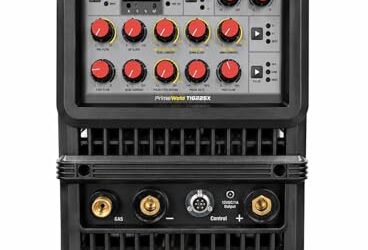
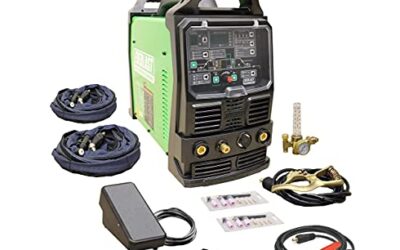
The TIG225X is the straightforward bench choice: a 225-amp AC/DC inverter with pulse, a CK17 flex-head torch on a Superflex cable, and a metal foot pedal supplied in the package, so heat control underfoot starts the day the box arrives. Its listed adjustments cover the full sequence, from pre-flow and up slope through pulse time on, AC balance and down slope, which suits fabricators moving between aluminum panels and stainless tube in one session. Dual voltage input keeps it usable on either shop circuit.
Specs
- Output: 225A AC/DC TIG and stick, IGBT inverter
- Input: dual voltage 110/220V
- Pulse time on: adjustable 10–90 percent
- AC frequency: 40–200 Hz; AC balance: 30–70 percent
- Flow and slope: pre-flow 0.1–1 s, up slope 0–10 s, down slope 0–25 s, post flow 1–10 s
- Torch: CK Worldwide 17 series Superflex with flex head
- Foot pedal: metal pedal supplied in the box
- Warranty: 3 years
Best for: Fabricators who want one AC/DC machine with the pedal included and a quality torch.
Watch out for: Confirm which torch length variant the listing ships, since cable length changes how far the machine can sit from the work.
ASIN: B07BXHRBQ8
AHP AlphaTIG 225Xi
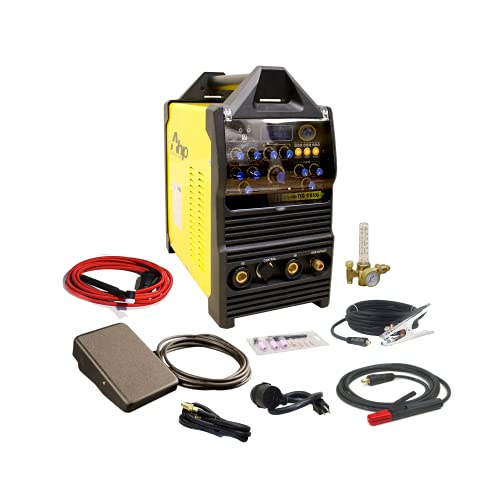
AHP rates the AlphaTIG 225Xi at a full 225 amps on 240V and a still-useful 150 amps on 120V, and the box contents settle the pedal question outright: a Nova foot pedal is listed among the included items alongside the torch, regulator and adapter plug. The pulse feature is fully adjustable across base amps, peak amps, frequency and the time split between stages, and the panel exposes AC frequency and AC balance rather than burying them in presets. A rear water cooler outlet leaves a path to a water-cooled torch later.
Specs
- Output: 225A AC/DC TIG and stick, IGBT inverter
- Output on 120V: 150A; full 225A on 240V
- Pulse frequency: 0.5–200 Hz, with adjustable peak and base amps
- Minimum start amps: 5A DC, 20A AC
- Pre-flow and post-flow: 0–10 s each
- Torch: SR26 straight neck, 12.5 ft cable
- Foot pedal: Nova foot pedal included
- Extra: water cooler outlet on the rear panel
Best for: Buyers who want a complete pedal-equipped package without a separate accessory order.
Watch out for: The included torch is a larger 26 series; check its size against the tight-access work you plan before assuming it fits everywhere.
ASIN: B096L9Y57J
Weldpro Digital TIG 200GD
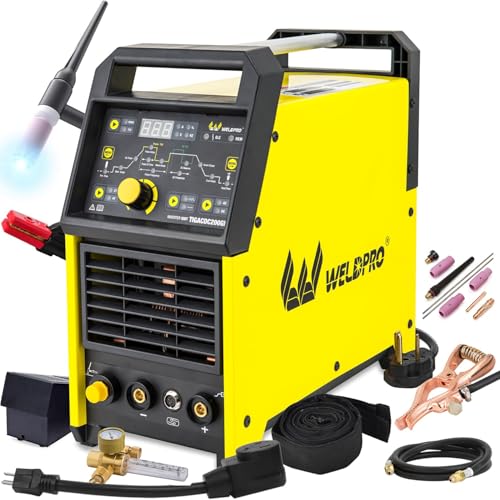
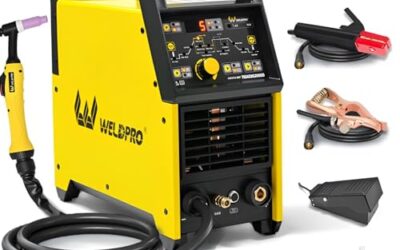
The Digital TIG 200GD pairs a digital front panel with a fully adjustable pulse: peak current from 10 to 90 percent and frequency from 0.5 to 200 Hz, plus start and end amps, up slope, down slope, AC balance and AC frequency. Weldpro includes a rocker style foot pedal, the design many welders prefer because it does not walk away mid-bead, and the package centres on a CK17 Superflex torch from CK Worldwide. A three-year warranty is stated in the listing title, which is worth noting at this end of the market.
Specs
- Output: 200A AC/DC TIG and stick
- Input: dual voltage 220V/110V
- Pulse: peak adjustable 10–90 percent, frequency 0.5–200 Hz
- Controls: start and end amps, up slope, down slope, AC balance, AC frequency, 2T/4T
- Torch: CK17 Worldwide Superflex
- Foot pedal: rocker style pedal included
- Warranty: 3 years
Best for: Welders who want digital pulse control and a rocker pedal without moving up a class.
Watch out for: Rocker pedals control amperage differently from treadle pedals; if you already own a spare pedal, verify connector compatibility before counting on it.
ASIN: B084PY4C59
Everlast PowerTIG 210EXT

Everlast builds the 210EXT around a digital microprocessor panel with two distinct pulse systems: a standard pulse for AC and DC work, and an advanced AC pulse that alternates polarity for fast freeze control on thin aluminum and deeper bite on thick plate. Three AC waveforms, advanced square, soft square and triangular, give the arc a different character per material, and nine memory channels store complete setups for repeat jobs. The package includes a foot pedal as standard equipment, and the maker backs the unit with a five-year warranty.
Specs
- Output: 210A AC/DC TIG, DC stick, IGBT module inverter
- Input: dual voltage 110/220V, single phase
- Pulse: standard pulse plus advanced AC pulse mode
- AC waveforms: advanced square, soft square and triangular
- Memory: 9 programmable channels
- Duty cycle: 60 percent at 210A TIG on 240V
- Foot pedal: included as standard equipment
- Item weight: 60 lb; dimensions 24 x 9 x 17 in
- Warranty: 5 years
Best for: Shops running repeat aluminum and stainless jobs that benefit from saved programs.
Watch out for: At 60 lb this is a bench machine, not a carry-around unit; plan a cart or a fixed home for it.
ASIN: B00NAC9Y1Q
ARCCAPTAIN TIG200P AC/DC

The TIG200P packs AC and DC TIG, pulse in both modes, spot TIG and stick into a housing that weighs about 26.5 lb, which makes it the machine here that realistically rides to the job. Its panel adjusts the full parameter chain, including pulse frequency from 0.2 to 200 Hz and AC balance from 30 to 70 percent, with square and triangular waveform options on AC. The catch sits in the control methods line: foot pedal remote control is supported, but the standard package leaves the pedal as a separate purchase or a bundle upgrade.
Specs
- Output: 200A AC/DC TIG and stick, 7-in-1 multiprocess
- Input: dual voltage 110/220V; TIG output limited to 120A on 110V
- Pulse frequency: 0.2–200 Hz; AC balance: 30–70 percent
- Waveforms: square and triangular on AC, plus spot TIG mode
- Foot pedal: supported, not included with the standard package
- Weight: about 26.5 lb
- Duty cycle: 25 percent at maximum output
Best for: Mobile welders who value low weight and can add the matched pedal as a bundle.
Watch out for: Order the pedal variant or the separate pedal listed for this model at the same time, or the machine arrives without underfoot control.
ASIN: B0C1N4J3GX
Which One Fits Your Situation
You Weld Thin Stainless at a Fixed Bench
Choose the PrimeWeld TIG225X or the AHP AlphaTIG 225Xi. Both put a pedal in the box and offer pulse ranges that let you drop background current between peaks, which is what keeps thin tube from blowing through. The AHP starts as low as 5 amps on DC, a genuine advantage on the thinnest stock.
You Repeat the Same Joints Every Week
The Everlast PowerTIG 210EXT fits production habits best. Nine memory channels hold complete parameter sets, so switching between an aluminum bracket and a stainless flange becomes a recall rather than a re-tune. Its advanced AC pulse also helps when the same thin-gauge part runs all day and heat soak keeps building.
You Are Setting Up Your First TIG Station
The Weldpro Digital TIG 200GD keeps the first setup simple: digital readouts instead of unmarked knobs, a rocker pedal included, and a CK torch that most suppliers stock parts for. The AHP is the alternative if you would rather have a 26 series torch and a water cooler outlet ready for later upgrades.
The Welder Travels to Site Work
Take the ARCCAPTAIN TIG200P AC/DC. At roughly 26.5 lb it is half the weight of the Everlast, and it still offers AC pulse for aluminum repairs away from the shop. Budget for the matched foot pedal when you order, since the standard package supports one without including it, and remote control matters most on awkward site joints.
Common Mistakes
- Assuming a pedal is in the box because the listing mentions foot pedal control; supported and included are different packages.
- Buying a spare pedal by connector shape alone, without matching the pin count and potentiometer value the machine expects.
- Setting pulse frequency high for every job, when slow pulses give beginners visible puddle control on thin sheet.
- Judging a machine by its 240V output while planning to run it from a 120V garage circuit with a much lower ceiling.
- Ignoring duty cycle on long seams, then blaming the machine for thermal shutdowns the spec sheet predicted.
Frequently Asked Questions
Does every pulse TIG welder here include a foot pedal?
No. Four of the five ship with a pedal in the package: the PrimeWeld, AHP, Weldpro and Everlast. The ARCCAPTAIN TIG200P supports foot pedal remote control, but its standard package sells the pedal separately or as a bundle variant. Always read the box contents line of the exact listing variant before ordering.
What does pulse frequency actually change at the arc?
Frequency sets how often the current switches between peak and background each second. Slow settings around a pulse or two per second let you time filler dabs to each peak, while high settings up to 200 Hz on these machines tighten the arc cone and add stiffness on corners and fillets without raising average heat as much.
Can I use a pedal and pulse at the same time?
Yes, on these machines the two systems do different jobs. The pedal varies your welding current in real time between the panel limits, while the pulse function cycles current between peak and background values at the set frequency. Many welders run a moderate pulse for puddle control and still ride the pedal to taper at the end of a bead.
Is AC output necessary if I mostly weld steel?
Not for steel or stainless, which weld on DC. AC matters when aluminum enters the picture, because its cleaning action breaks up the oxide layer. Every machine in this guide offers AC/DC output, so the choice is really about pulse depth, pedal packaging and duty cycle rather than process coverage.
Related guides
More from Amazon
Programs that pair well with the guide above. Offers and eligibility are set by Amazon and may change.
Free shipping on eligible items, Prime Video and more. Eligible new members can start with a free trial.
Start a Prime free trialAudiobooks and podcasts to listen to on the go. Eligible new members can start with a free trial.
Try Audible freeAd-free music streaming. Eligible new subscribers can start with a free trial.
Try Music Unlimited freeA free business account with business pricing and bulk-buying tools for work, shop or home office.
Create a business accountAs an Amazon Associate we earn from qualifying purchases.



Write Your Review
No reviews yet. Be the first to share your experience!