
Key takeaways
- The best pulse tig welders for small metalworking shops: 4 AC/DC machines with pulse control, dual voltage and foot pedals, chosen from Amazon listings.
What's inside
As an Amazon Associate I earn from qualifying purchases. This post may contain affiliate links at no extra cost to you.
A small metalworking shop asks a TIG welder to do more than one job. One morning the machine joins thin stainless brackets, and by afternoon it is laying beads on an aluminum repair panel that cannot take much heat. The buyer is really deciding how much control to pay for: a machine that only runs DC handles steel and stainless, while an AC/DC machine with pulse opens up aluminum and thin sheet without warping it. The wrong choice shows up fast, as burned edges, a puddle that runs away, or a machine that cannot hold a steady arc at low amps.
This guide is for owners of small fabrication shops, mobile repair welders, and hobby fabricators moving from a basic stick or MIG setup to their first pulse TIG machine. Each of the four welders below was chosen from the names and specifications shown on its Amazon product page, with pulse control, dual-voltage input, and the included torch and pedal setup weighed for small-shop use.
Quick Picks
As an Amazon Associate we earn from qualifying purchases.
| Product | Best for | Key spec from title |
|---|---|---|
| PrimeWeld TIG225X | One machine for aluminum and steel | 225 Amp IGBT AC DC Tig/Stick Welder with Pulse |
| YESWELDER TIG-250P | High-amperage shop work | 250 Amp AC/DC Aluminum Tig Welder with Pulse |
| Weldpro 200A AC/DC TIG Welder | A complete kit out of the box | 200A AC/DC TIG Welder with Pulse, 110V/220V Dual Voltage |
| ARCCAPTAIN TIG200P AC/DC | A compact bench machine | ARCCAPTAIN TIG Welder AC/DC 200Amp with Pulse |
How to Choose
AC output decides whether aluminum is on the table
Aluminum TIG welding needs alternating current to break up the oxide layer on the surface, so a DC-only machine cannot weld it no matter how skilled the operator is. Every welder in this guide is an AC/DC machine, which means the same unit can join aluminum brackets in the morning and stainless tubing after lunch. Check the listing for the words AC/DC rather than assuming a machine handles aluminum because it has a pulse setting. Some budget TIG welders advertise pulse but run DC only, and that distinction matters more than any other single feature when a shop takes on mixed-metal jobs.
Pulse control is what protects thin material
Pulse mode alternates the arc between a high peak current and a lower background current, which lets the puddle cool slightly between pulses and keeps heat input down on thin sheet. Look for an adjustable pulse frequency rather than a simple on-off pulse switch, because different thicknesses respond to different settings. The machines below list pulse frequency ranges from 0.2 Hz up to 200 Hz, and that range is what lets a welder slow the heat on a thin stainless edge or speed it up on a thicker aluminum joint. A machine with a wide pulse range gives a small shop more room to grow into harder jobs.
Dual voltage input fits a shop that moves around
A welder that runs on both 120 V and 240 V can plug into a standard wall outlet for light work and switch to a 240 V circuit when the job needs full amperage. All four machines here list dual-voltage input, but maximum output drops on 120 V, so a 225-amp machine may only reach about 140 amps there. Plan the shop’s wiring around the work that needs the most power, and confirm the circuit can carry the input current the listing states. A machine bought for a 240 V shop that later moves to a site with only 120 V outlets will still weld, just at reduced output.
The torch, pedal, and duty cycle set the real working limits
The torch that ships in the box decides how comfortable long welds feel, and a flex-head torch reaches into corners a rigid torch cannot. A foot pedal matters just as much, because it lets the welder raise and lower heat without stopping to turn a knob, and one machine in this guide ships without a pedal at all. Duty cycle tells how long the machine can weld at a given amperage before it must cool, so a 40% duty cycle at maximum output means four minutes of welding in every ten at full power. Compare that figure at the amperage the shop actually uses, not only at maximum output.
The 4 Best Options
PrimeWeld TIG225X

The PrimeWeld TIG225X suits a small shop that wants one machine to cover aluminum, stainless, and mild steel without keeping a second welder on the shelf. Its 225-amp ceiling at 240 V gives enough headroom for thicker aluminum panels, while the pulse control and adjustable AC settings keep thin material from overheating. The CK17 Superflex torch with a flex head is the part owners mention most, because it bends into tight joints and stays comfortable during long beads. A rocker-style foot pedal comes in the box, and the 3-year warranty gives the shop a clear support window.
- Specs:
- 225 A maximum TIG output at 240 V, 140 A at 120 V
- AC/DC TIG and stick welding with IGBT inverter technology
- Pulse frequency range 0.5–200 Hz
- CK17 Superflex torch with flex head included
- Dual voltage 120/240 V input
- 40% duty cycle at maximum output
- 3-year warranty
- Best for: A shop that welds aluminum and steel in the same week and wants one machine for both.
- Watch out for: The Amazon listing describes the CK17 torch package, and the current maker page shows newer waveform features that the Amazon listing does not confirm, so check which revision the listing ships.
YESWELDER TIG-250P

The YESWELDER TIG-250P fits a shop that needs the highest amperage in this group for thick aluminum and heavy stainless work. Its software-controlled square wave AC/DC output and digital setup for pre-gas, start current, up-slope, down-slope, finish current, and post-gas give the operator a full welding cycle to tune rather than a few knobs. The machine saves its settings when power is cut, which helps a shop that repeats the same joint on different days. A 2T/4T trigger choice keeps long welds comfortable when a pedal is not in use.
- Specs:
- 250 A maximum AC/DC TIG and stick output
- Software-controlled square wave AC/DC inverter
- Pulse control for aluminum and stainless welding
- Digital settings for pre-gas, start current, up-slope, down-slope, finish current, and post-gas
- 2T/4T trigger modes with autosave of welding parameters
- 220 V input per the Amazon listing title
- 60% duty cycle at 250 A TIG
- Best for: A shop that runs thick aluminum jobs and wants the most amperage per machine in this guide.
- Watch out for: A foot pedal is not included in the box, so budget for one separately if pedal heat control matters to the shop.
Weldpro 200A AC/DC TIG Welder
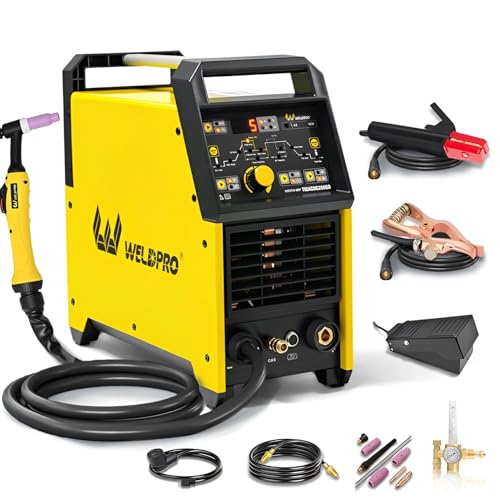
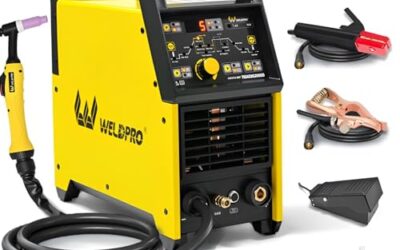
The Weldpro 200A AC/DC TIG Welder suits a shop that wants a complete kit without ordering accessories separately. The box includes a TIG torch and a foot pedal, and the machine covers AC TIG, DC TIG, AC pulse TIG, DC pulse TIG, and stick in one unit. Its 200-amp output handles the aluminum and stainless jobs a small shop sees most often, and dual-voltage input lets it run on either shop circuit. The listing is sold through the Weldpro Amazon store, which keeps the source of the machine clear for warranty questions.
- Specs:
- 200 A AC/DC TIG output with pulse
- Five modes: AC TIG, DC TIG, AC pulse TIG, DC pulse TIG, and stick
- Dual voltage 110/220 V input
- TIG torch and foot pedal included in the box
- Model TIG200-KT26 per the Amazon listing
- 40% duty cycle at 200 A
- Best for: A shop buying its first pulse TIG machine that wants the torch and pedal in the same box.
- Watch out for: An older Weldpro 200GD listing still circulates under a different ASIN, so confirm the listing shows model TIG200-KT26 before ordering.
ARCCAPTAIN TIG200P AC/DC

The ARCCAPTAIN TIG200P AC/DC fits a bench where space is tight and the machine moves between jobs. At about 26.5 pounds it is the lightest welder in this guide, yet it still offers AC/DC TIG, pulse, stick, and timed spot welding. The large LED display makes the settings easy to read from a standing position, and the pulse range from 0.2 to 200 Hz covers both slow thin-sheet work and faster aluminum passes. Square and triangular AC waveforms give the operator two more ways to shape the arc on aluminum.
- Specs:
- 200 A AC/DC TIG output with pulse
- Pulse frequency range 0.2–200 Hz
- AC balance range 30–70%
- Seven modes including DC TIG, DC pulse TIG, AC TIG, AC pulse TIG square, AC pulse TIG triangular, stick, and spot TIG
- Dual voltage 120/240 V input
- About 26.5 lb with a large LED display
- 25% duty cycle at 200 A
- Best for: A compact bench setup that needs aluminum capability in a machine light enough to carry.
- Watch out for: The maker lists five years for core components while the Amazon listing states three years of service, so confirm which warranty terms apply before buying.
Which One Fits Your Situation
One machine for aluminum and steel in the same shop
Choose the PrimeWeld TIG225X when the shop welds aluminum brackets and stainless tubing in the same week and wants a single machine for both. Its 225-amp output covers thicker aluminum than the 200-amp machines, and the CK17 flex-head torch reaches joints that a rigid torch cannot. The included foot pedal keeps heat control underfoot during long beads, which matters when a job runs across an afternoon.
Thick aluminum jobs that need the most power
Choose the YESWELDER TIG-250P when the shop’s hardest jobs are thick aluminum panels or heavy stainless sections that need more than 200 amps. Its digital cycle settings let the operator set the full weld sequence in advance, and the autosave keeps those settings ready for the next identical joint. Order a foot pedal with it, since the box does not include one.
A first pulse TIG machine with nothing left to buy
Choose the Weldpro 200A AC/DC TIG Welder when the shop wants to start welding the day the box arrives. The torch and foot pedal are already included, and the five welding modes cover the AC, DC, pulse, and stick work a small shop meets most often. Its 200-amp output is enough for the aluminum and stainless jobs that fill a typical small-shop schedule.
A tight bench and a machine that moves
Choose the ARCCAPTAIN TIG200P AC/DC when bench space is short and the welder needs to move between a bench, a cart, and a job site. At about 26.5 pounds it carries easily, and the LED display keeps settings visible without crouching over the panel. The spot TIG mode adds a useful option for tacking sheet metal before a full bead.
Common Mistakes
- Buying a DC-only TIG welder and discovering it cannot weld aluminum at all.
- Choosing a machine by its maximum amperage without checking what it reaches on a 120 V circuit.
- Ignoring duty cycle, then hitting thermal shutdown halfway through a long joint.
- Ordering a machine without checking whether the foot pedal is included in the box.
- Setting pulse frequency by guesswork instead of trying it on scrap of the same thickness first.
Frequently Asked Questions
Do I need AC output to weld aluminum with a TIG welder?
Yes. Aluminum carries an oxide layer that alternating current breaks up during the weld. A DC-only TIG welder can join steel and stainless, but it cannot produce a sound aluminum weld. Every machine in this guide is an AC/DC model. Check for AC/DC before buying, since pulse alone does not make a machine aluminum-capable.
What does pulse actually do on a TIG welder?
Pulse alternates between a high peak and a lower background current, which lets the puddle cool briefly between pulses. That lower heat input protects thin sheet from warping and burn-through and steadies the bead on stainless and aluminum. An adjustable pulse frequency matters more than a simple on-off switch, because thin and thick material respond best to different pulse rates.
Can these welders run on a standard 120 V outlet?
Yes, all four machines here list dual-voltage input and run on 120 V as well as 240 V. Maximum output drops on 120 V, so a 225-amp machine may only reach about 140 amps there. Light sheet work runs fine on 120 V, while thicker aluminum and long welds need the 240 V circuit for full output.
Is a foot pedal necessary for pulse TIG welding?
A foot pedal is not necessary, since the torch trigger and panel can control the weld, but most welders prefer one for heat control. A pedal lets the operator raise current to start the puddle and ease it down to finish a bead. Three here include a pedal, while the YESWELDER TIG-250P ships without one, so check the box contents first.
Related guides
More from Amazon
Programs that pair well with the guide above. Offers and eligibility are set by Amazon and may change.
Free shipping on eligible items, Prime Video and more. Eligible new members can start with a free trial.
Start a Prime free trialAudiobooks and podcasts to listen to on the go. Eligible new members can start with a free trial.
Try Audible freeAd-free music streaming. Eligible new subscribers can start with a free trial.
Try Music Unlimited freeA free business account with business pricing and bulk-buying tools for work, shop or home office.
Create a business accountAs an Amazon Associate we earn from qualifying purchases.



Write Your Review
No reviews yet. Be the first to share your experience!